
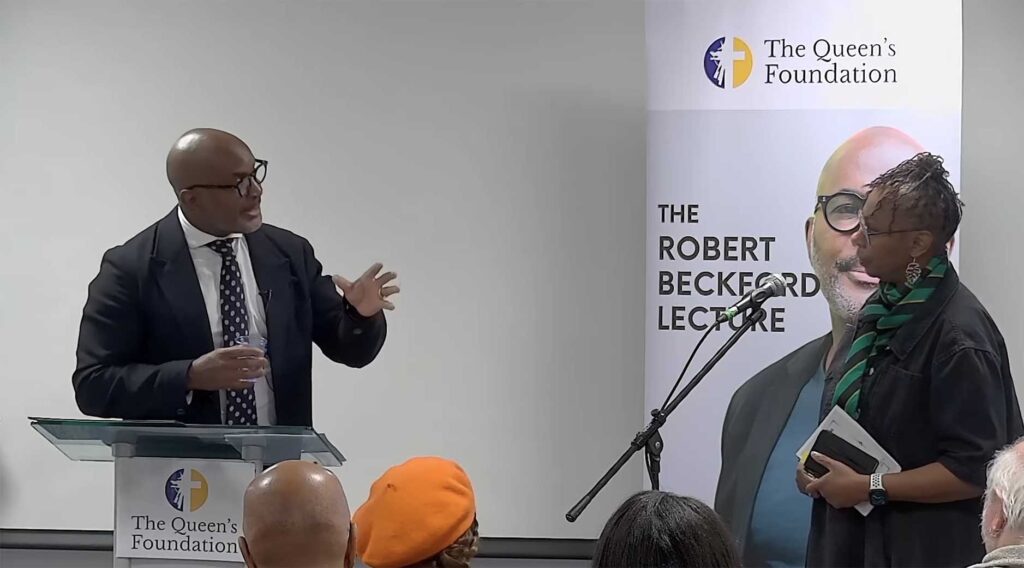
This inaugural lecture asks what kind of Christian thought is vital in a world marked by the resurgence of neofascism and the emergence of cryptic forms of reparations.
These developments expose the limits of traditional theological categories, which too often remain silent before the realities of racial injustice and global inequality. Building on my earlier interventions—Dread as a lens for Christology and hermeneutics, and Exporcism as a practice of unmasking colonial spirits—I propose new critical perspectives drawn from Jamaican cultural concepts.
Fass names audacity, the disruptive courage to speak truth in contexts that demand silence. Ginnal signals cunning, the capacity to discern and resist duplicity in political, cultural, and ecclesial life. Together, these categories open a fresh theological grammar for our age: one that insists on prophetic boldness while navigating the deceptive terrains of racial politics, memory, and power.
By placing Caribbean vernacular knowledge in dialogue with Christian theology, the lecture seeks to reimagine theological agency. Fass theology, attentive to the tactics of the ginnal, offers not merely survival but a transformative vision for faith and politics in the twenty-first century.
These developments expose the limits of traditional theological categories, which too often remain silent before the realities of racial injustice and global inequality. Building on my earlier interventions—Dread as a lens for Christology and hermeneutics, and Exporcism as a practice of unmasking colonial spirits—I propose new critical perspectives drawn from Jamaican cultural concepts.
Fass names audacity, the disruptive courage to speak truth in contexts that demand silence. Ginnal signals cunning, the capacity to discern and resist duplicity in political, cultural, and ecclesial life. Together, these categories open a fresh theological grammar for our age: one that insists on prophetic boldness while navigating the deceptive terrains of racial politics, memory, and power.
By placing Caribbean vernacular knowledge in dialogue with Christian theology, the lecture seeks to reimagine theological agency. Fass theology, attentive to the tactics of the ginnal, offers not merely survival but a transformative vision for faith and politics in the twenty-first century.
These developments expose the limits of traditional theological categories, which too often remain silent before the realities of racial injustice and global inequality. Building on my earlier interventions—Dread as a lens for Christology and hermeneutics, and Exporcism as a practice of unmasking colonial spirits—I propose new critical perspectives drawn from Jamaican cultural concepts.
Fass names audacity, the disruptive courage to speak truth in contexts that demand silence. Ginnal signals cunning, the capacity to discern and resist duplicity in political, cultural, and ecclesial life. Together, these categories open a fresh theological grammar for our age: one that insists on prophetic boldness while navigating the deceptive terrains of racial politics, memory, and power.
By placing Caribbean vernacular knowledge in dialogue with Christian theology, the lecture seeks to reimagine theological agency. Fass theology, attentive to the tactics of the ginnal, offers not merely survival but a transformative vision for faith and politics in the twenty-first century.
Aliquam a gravida ligula. Curabitur justo dolor, tristique euismod ipsum dignissim, blandit facilisis ex. Cras dictum lacus nec quam eleifend, mollis rutrum velit mattis.

Aliquam a gravida ligula. Curabitur justo dolor, tristique euismod ipsum dignissim, blandit facilisis ex. Cras dictum lacus nec quam eleifend, mollis rutrum velit mattis.

Aliquam a gravida ligula. Curabitur justo dolor, tristique euismod ipsum dignissim, blandit facilisis ex. Cras dictum lacus nec quam eleifend, mollis rutrum velit mattis.

Aliquam a gravida ligula. Curabitur justo dolor, tristique euismod ipsum dignissim, blandit facilisis ex. Cras dictum lacus nec quam eleifend, mollis rutrum velit mattis.